Pretrained Models
You can run any of the four supported RF-DETR base models -- Nano, Small, Medium, Large -- with Inference, an open source computer vision inference server. The base models are trained on the Microsoft COCO dataset. These base models are Apache 2.0, so they're commercially usable out of the box. XLarge and 2XLarge detection models are also available via pip install rfdetr[plus] under the Roboflow Platform Model License (PML 1.0): commercial use is included when you deploy on Roboflow, and commercial self-hosting requires the Enterprise add-on.
To run RF-DETR on an image, use the following code:
import os
import supervision as sv
from inference import get_model
from PIL import Image
from io import BytesIO
import requests

url = "https://media.roboflow.com/dog.jpeg"
image = Image.open(BytesIO(requests.get(url).content))

model = get_model("rfdetr-large")

predictions = model.infer(image, confidence=0.5)[0]

detections = sv.Detections.from_inference(predictions)

labels = [prediction.class_name for prediction in predictions.predictions]

annotated_image = image.copy()
annotated_image = sv.BoxAnnotator().annotate(annotated_image, detections)
annotated_image = sv.LabelAnnotator().annotate(annotated_image, detections, labels)

sv.plot_image(annotated_image)
Above, replace the image URL with any image you want to use with the model.
Here are the results from the code above:
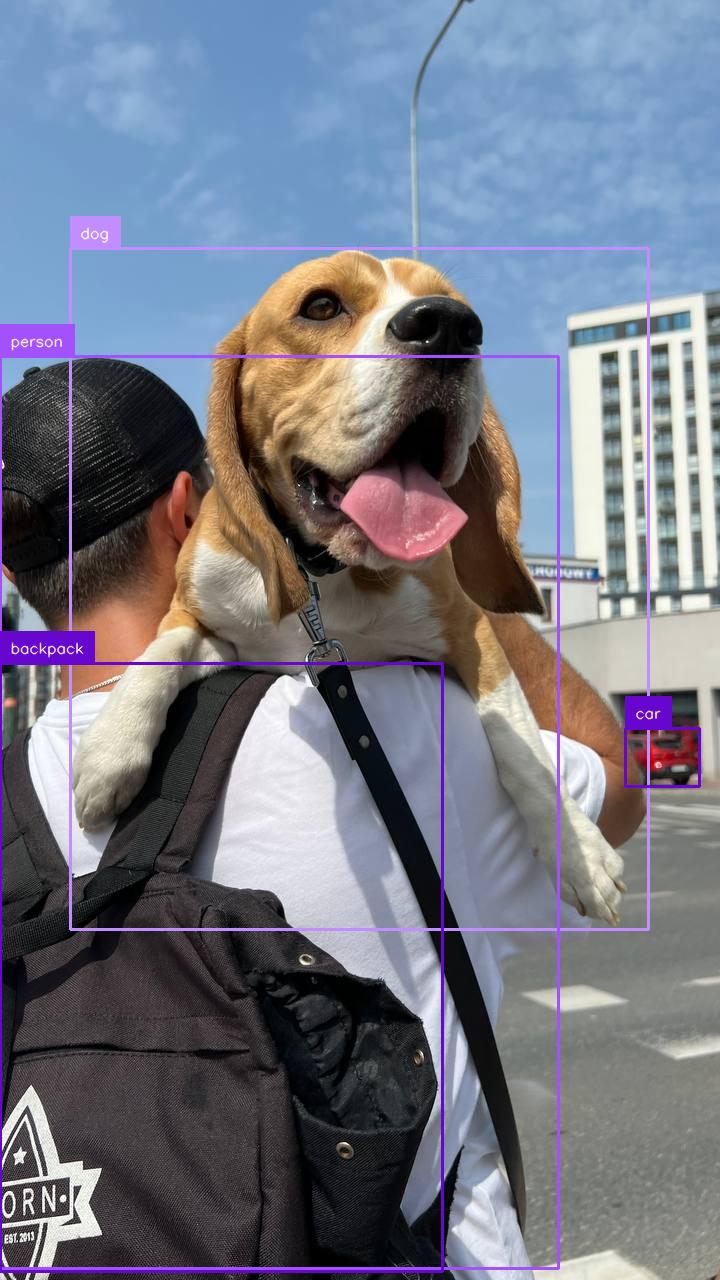
To run RF-DETR on a video file, use the following code:
import supervision as sv
from rfdetr import RFDETRMedium
from rfdetr.assets.coco_classes import COCO_CLASSES

model = RFDETRMedium()


def callback(frame, index):
    detections = model.predict(frame[:, :, ::-1], threshold=0.5)

    labels = [
        f"{COCO_CLASSES[class_id]} {confidence:.2f}"
        for class_id, confidence in zip(detections.class_id, detections.confidence)
    ]

    annotated_frame = frame.copy()
    annotated_frame = sv.BoxAnnotator().annotate(annotated_frame, detections)
    annotated_frame = sv.LabelAnnotator().annotate(annotated_frame, detections, labels)
    return annotated_frame


sv.process_video(
    source_path="<SOURCE_VIDEO_PATH>",
    target_path="<TARGET_VIDEO_PATH>",
    callback=callback,
)
Above, set your SOURCE_VIDEO_PATH and TARGET_VIDEO_PATH to the directories of the video you want to process and where you want to save the results from inference, respectively.
To run RF-DETR on a webcam input, use the following code:
import cv2
import supervision as sv
from rfdetr import RFDETRMedium
from rfdetr.assets.coco_classes import COCO_CLASSES

model = RFDETRMedium()

cap = cv2.VideoCapture(0)
while True:
    success, frame = cap.read()
    if not success:
        break

    detections = model.predict(frame[:, :, ::-1], threshold=0.5)

    labels = [
        f"{COCO_CLASSES[class_id]} {confidence:.2f}"
        for class_id, confidence in zip(detections.class_id, detections.confidence)
    ]

    annotated_frame = frame.copy()
    annotated_frame = sv.BoxAnnotator().annotate(annotated_frame, detections)
    annotated_frame = sv.LabelAnnotator().annotate(annotated_frame, detections, labels)

    cv2.imshow("Webcam", annotated_frame)

    if cv2.waitKey(1) & 0xFF == ord("q"):
        break

cap.release()
cv2.destroyAllWindows()
To run RF-DETR on an RTSP (Real Time Streaming Protocol) stream, use the following code:
import cv2
import supervision as sv
from rfdetr import RFDETRMedium
from rfdetr.assets.coco_classes import COCO_CLASSES

model = RFDETRMedium()

cap = cv2.VideoCapture("<RTSP_STREAM_URL>")
while True:
    success, frame = cap.read()
    if not success:
        break

    detections = model.predict(frame[:, :, ::-1], threshold=0.5)

    labels = [
        f"{COCO_CLASSES[class_id]} {confidence:.2f}"
        for class_id, confidence in zip(detections.class_id, detections.confidence)
    ]

    annotated_frame = frame.copy()
    annotated_frame = sv.BoxAnnotator().annotate(annotated_frame, detections)
    annotated_frame = sv.LabelAnnotator().annotate(annotated_frame, detections, labels)

    cv2.imshow("RTSP Stream", annotated_frame)

    if cv2.waitKey(1) & 0xFF == ord("q"):
        break

cap.release()
cv2.destroyAllWindows()
You can change the RF-DETR model that the code snippet above uses. To do so, update rfdetr-small to any of the following values:
rfdetr-nanorfdetr-smallrfdetr-mediumrfdetr-large
Predict with the Python package
Use RFDETRSmall to run prediction with the RF-DETR Python package:
from rfdetr import RFDETRSmall

model = RFDETRSmall()
detections = model.predict("https://media.roboflow.com/dog.jpeg", threshold=0.5)
predict() accepts RGB PIL images and NumPy arrays. It accepts normalized CHW tensors and normalized BCHW tensor batches. It also accepts image paths, HTTP image URLs, pathlib.Path objects, and os.PathLike objects. An extensionless HTTP URL is treated as an image URL.
One image returns one sv.Detections or sv.KeyPoints object. An iterable of images, such as a list, tuple, or generator, returns a list of results from one batched forward pass. A BCHW tensor returns one result per image.
The model's predict() handles images only. Use RFDETRInference for videos, folders, globs, manifests, cameras, network streams, and lazy results. RFDETRInference(model) borrows a loaded model without copying its weights. It also loads checkpoints and exported models, and accepts every image input above. See Run on Videos and Streams for each source, with example clips.
Include source images
include_source_image=True by default. For sv.Detections, the source image is stored in metadata. For sv.KeyPoints, it is stored in each object's data.
RF-DETR copies source images for result storage. It converts them to uint8 RGB arrays. Set include_source_image=False to omit source images.
Batch Inference
You can provide .predict() with either a single image or a list of images. When multiple images are supplied, they are processed together in a single forward pass, resulting in a corresponding list of detections.
import io
import requests
import supervision as sv
from PIL import Image
from rfdetr import RFDETRMedium
from rfdetr.assets.coco_classes import COCO_CLASSES

model = RFDETRMedium()

urls = [
    "https://media.roboflow.com/notebooks/examples/dog-2.jpeg",
    "https://media.roboflow.com/notebooks/examples/dog-3.jpeg",
]

images = [Image.open(io.BytesIO(requests.get(url).content)) for url in urls]

detections_list = model.predict(images, threshold=0.5)

for image, detections in zip(images, detections_list):
    labels = [
        f"{COCO_CLASSES[class_id]} {confidence:.2f}"
        for class_id, confidence in zip(detections.class_id, detections.confidence)
    ]

    annotated_image = image.copy()
    annotated_image = sv.BoxAnnotator().annotate(annotated_image, detections)
    annotated_image = sv.LabelAnnotator().annotate(annotated_image, detections, labels)

    sv.plot_image(annotated_image)